
Dans le cadre de l'ANR DEMIG, Demos et Migrations - deux séminaires organisés lundi 23 novembre (Campus Carlone) et mardi 8 décembre (Campus Trotabas)
- Formation
- International
- Recherche
Publié le 23 octobre 2026
–
Mis à jour le 23 octobre 2026
Date(s)
du 23 novembre 2026 au 8 décembre 2026
Lieu(x)
Campus Carlone, Campus Trotabas
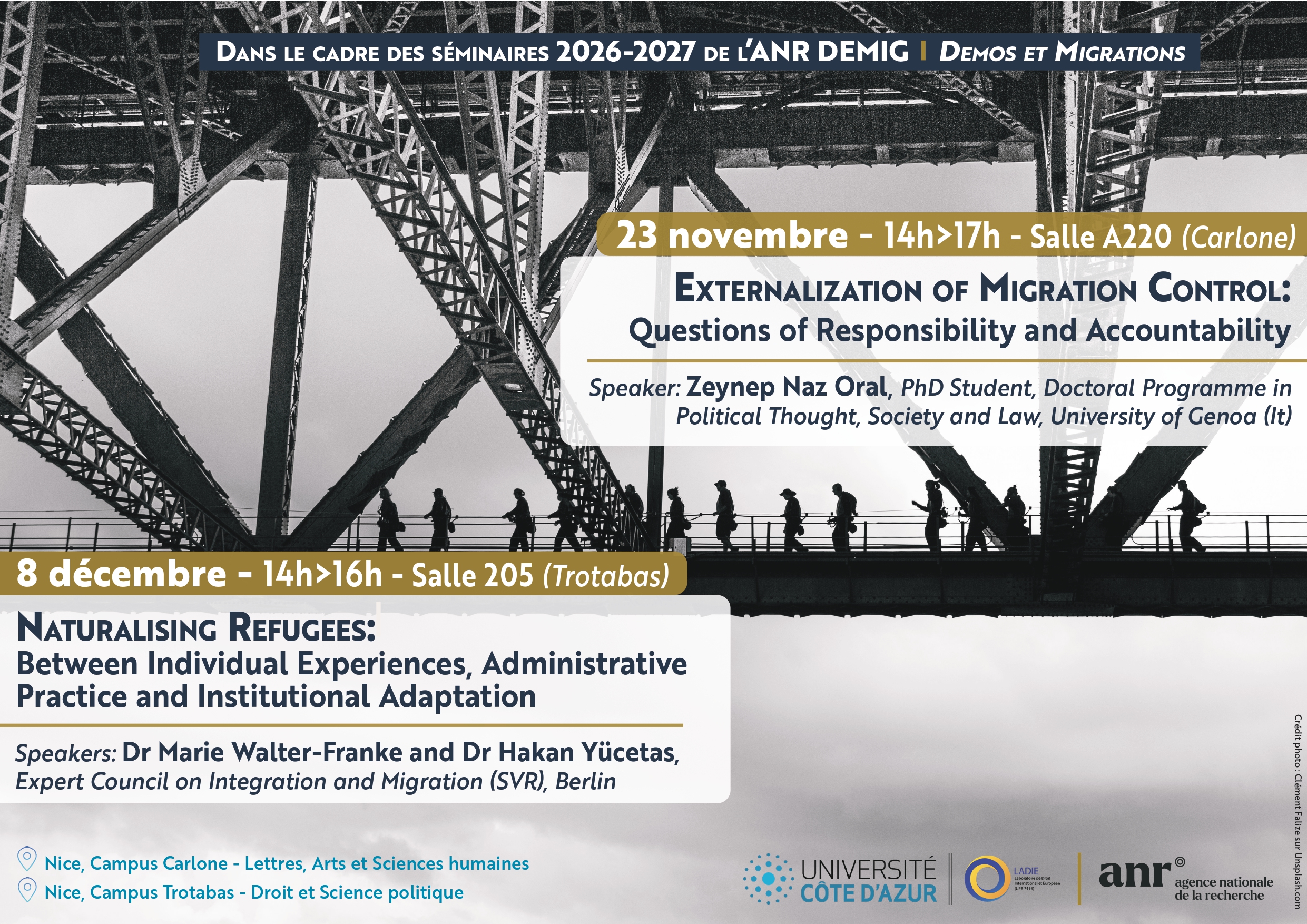
Dans le cadre des séminaires 2026-2027 de l’ANR DEMIG – Demos et Migrations
Séminaire : “Externalization of Migration Control: Questions of Responsibility and Accountability“
- Speaker: Zeynep Naz Oral, PhD Student, Doctoral Programme in Political Thought, Society and Law, University of Genoa (It)
This lecture explores the externalization of migration control in EU law and policy, focusing on how the EU and its Member States exercise border control beyond their territorial boundaries. It looks at how legal instruments and cooperation with third countries extend migration control and distance states from the legal consequences of their actions. These practices also affect access to international protection and the legal boundaries of extraterritorial jurisdiction and state responsibility. The lecture then turns to Italy's cooperation with Libya and the jurisprudence of the European Court of Human Rights to explore the tensions between the exercise of state power and the reach of legal responsibility
23 novembre – 14h-17h
Salle A220 - Campus Carlone - Lettres, Arts et Sciences humaines
Séminaire : “Naturalising Refugees: Between Individual Experiences, Administrative Practice and Institutional Adaptation"
- Speakers: Dr Marie Walter-Franke and Dr Hakan Yücetas, Expert Council on Integration and Migration (SVR), Berlin
Naturalisation tends to improve immigrants’ life chances and opportunities. For refugees in particular, acquiring citizenship means securing their future and gaining full civil and political rights in their country of refuge. Yet applicants frequently face challenges and barriers within the naturalisation system, which can leave a lasting mark on their experiences. Besides naturalisation requirements themselves, applicants’ negative experiences are caused by structural problems in local naturalisation authorities in Germany, which are grappling with high application volumes, limited digitisation and staff shortages. The resulting lengthy processing and waiting times lead to frustration and stress among both applicants and street-level bureaucrats. A pre-existing tense situation in the administration escalated from 2021 onwards, when refugees who arrived in 2015/2016 in Germany started applying for naturalisation, while the 2024 reform of German citizenship law further boosted application numbers. Despite these challenges, naturalisation numbers have increased significantly, tripling from 2020 to 2025 to reach over 333.000. So far, little research was conducted on how refugees experience naturalisation and how the German administration has adapted to a growing workload and the transforming demographics among citizenship applicants. To contribute to closing this gap, this study conducted by the scientific staff of the Expert Council on Integration and Migration (SVR) explores both refugees’ and street-level bureaucrats’ perspectives. Using mixed methods, it draws on interviews with refugees from Syria, Iraq, Iran, Afghanistan, Eritrea and Ukraine and street-level bureaucrats across Germany, participant observation in ten German naturalisation offices, the quantitative analysis of official statistics and survey data as well as comparative research in Sweden and France. This study thus contributes to the growing body of empirical research that studies administrative practice in the field of naturalisation
8 décembre - 14h-16h
Salle Ulysse (205) – Campus Trotabas, Droit et Science politique
Date(s)
Du
23 novembre 2026 00:00
au 8 décembre 2026
Lieu(x)
Campus Carlone, Campus Trotabas